Hyderabad’s office leasing market has shifted noticeably over the past couple of years, and the trends shaping it aren’t abstract – they’re changing what businesses actually look for when choosing a workspace. Dallas Center, located in Knowledge City directly opposite T-Hub, sits at the intersection of several of these shifts. Here’s what’s actually trending, and what it means if you’re evaluating office space right now.
GCCs Are Now Setting the Pace, Not Just Following It
Global Capability Centres have moved from being a secondary demand driver to the leading force behind Hyderabad’s office leasing activity. What used to be a market shaped primarily by domestic IT and BFSI occupiers is now increasingly influenced by GCCs setting up or expanding India operations – and that shift changes what “good office space” means in practice. GCCs typically look for enterprise-grade infrastructure, strong compliance-ready security, and addresses that carry credibility with global leadership teams, not just functional desks.
This has a ripple effect even for businesses that aren’t GCCs themselves: buildings and corridors built to satisfy GCC-level expectations tend to raise the overall infrastructure bar for everyone leasing nearby.
Flexible and Managed Office Formats Are No Longer a Startup-Only Choice
Flex space operators have moved well beyond serving early-stage startups. Increasingly, established enterprises and even GCCs are choosing flexible or managed office formats over traditional long-term leases, largely because it lets them scale seating up or down without the multi-year commitment a conventional lease demands. This shift toward operational flexibility is one of the clearest trends in the current market – businesses want infrastructure and support handled for them, without losing the ability to adjust quickly as headcount or strategy changes.
For companies evaluating coworking spaces and managed office spaces in Hyderabad, this means the format itself is no longer seen as a compromise – it’s increasingly the preferred starting point, even for larger occupiers.
Grade A and Premium Space Is Now the Default Expectation
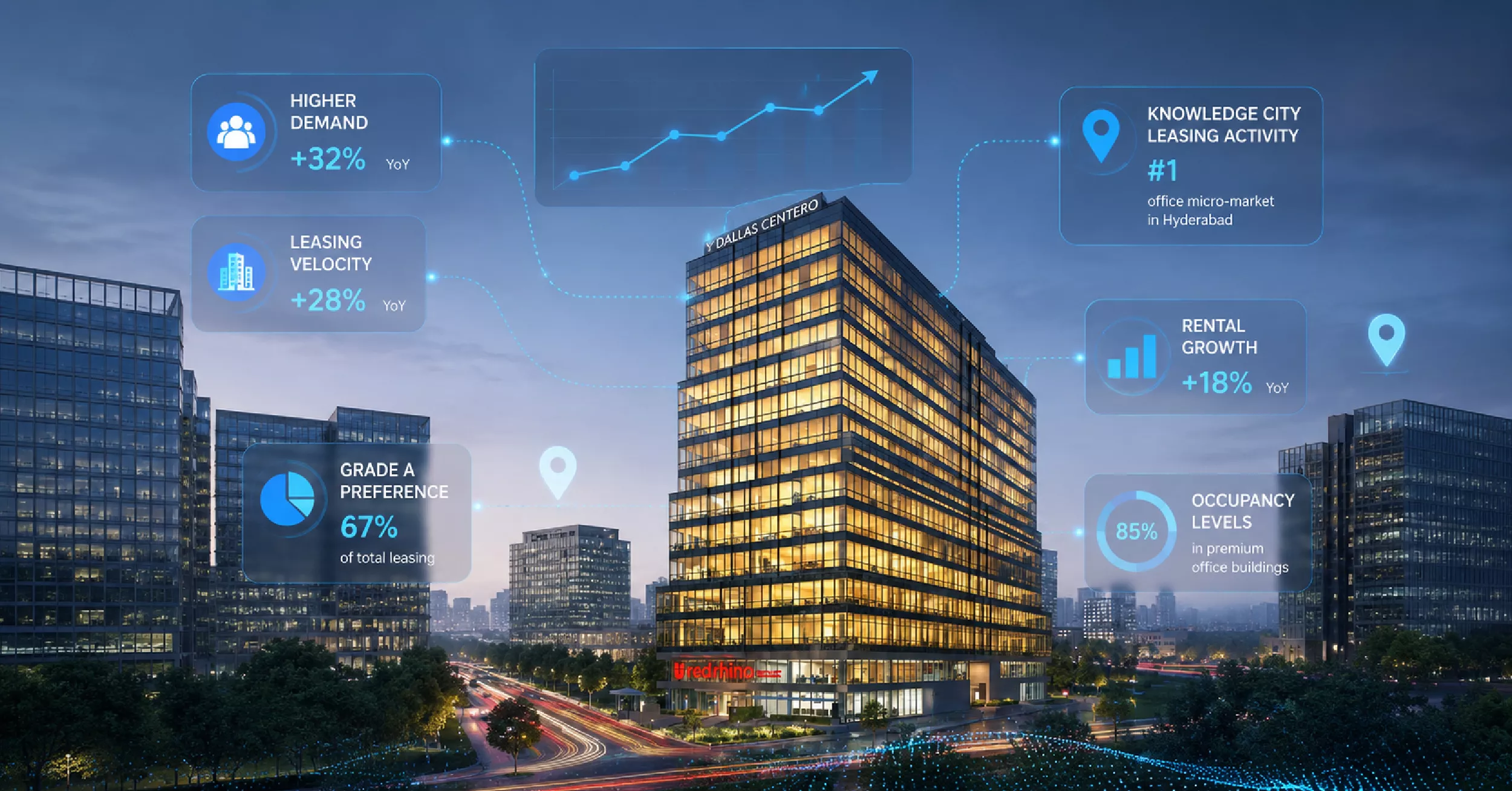
Occupier preference has clearly moved toward higher-quality, Grade A office space rather than settling for older or lower-spec stock. Businesses are less willing than before to trade infrastructure quality for a lower price point, particularly as remote and hybrid work options mean the physical office needs to actively justify itself – through amenities, design, and genuine day-to-day usability – rather than simply existing as a mandatory address.
This is part of why buildings like Dallas Center, operating from a Grade A commercial structure with professionally managed services, are positioned differently from older-generation office stock in the same broader corridor.
Large-Format, Consolidated Leasing Is Becoming More Common
Businesses are increasingly consolidating multiple smaller offices into single, larger leases rather than maintaining scattered locations across a city. This reflects a broader push toward operational efficiency – fewer addresses to manage, more centralised teams, and stronger internal collaboration when everyone sits under one roof. For growing businesses, this trend is worth watching even if you’re not yet at the scale to consolidate, since it signals where the market’s best inventory and attention is increasingly being directed.
Ecosystem Proximity Is Becoming a Genuine Selection Criterion
Where an office sits relative to innovation hubs, talent pools, and peer companies has become a more deliberate part of the leasing decision, not an afterthought. This is exactly where Dallas Center’s position in Knowledge City – directly opposite T-Hub, one of India’s largest startup incubators – stands out. Businesses increasingly want their address to say something about who they are and who they’re near, not just where they happen to be located.
What This Means If You’re Evaluating Office Space Now
Taken together, these trends point toward the same underlying shift: businesses want infrastructure quality, operational flexibility, and ecosystem relevance all at once, rather than trading one for another. A few practical takeaways:
- Don’t assume flexible formats mean lower quality – the market has moved past that association entirely.
- Location context matters as much as the building itself – proximity to an ecosystem like T-Hub’s is now a genuine differentiator, not just a nice-to-have.
- Ask how a provider is positioning for GCC-level expectations, even if you’re not a GCC – it’s a useful proxy for infrastructure and security quality.
Conclusion
Hyderabad’s office leasing market is being reshaped by GCC-driven demand, a growing comfort with flexible and managed formats, rising expectations for Grade A infrastructure, and a sharper focus on ecosystem proximity – and Dallas Center’s position in Knowledge City, right opposite T-Hub, reflects several of these trends directly. For businesses evaluating where to base their next office, understanding these shifts is as useful as touring the space itself. Explore Dallas Center in Knowledge City to see how this fits your team, or browse The Headquarters’ full range of locations across Hyderabad.